


Where the “trusted advisor” gap really costs you

Post by
Bob Apollo
October 11, 2026
October 11, 2026
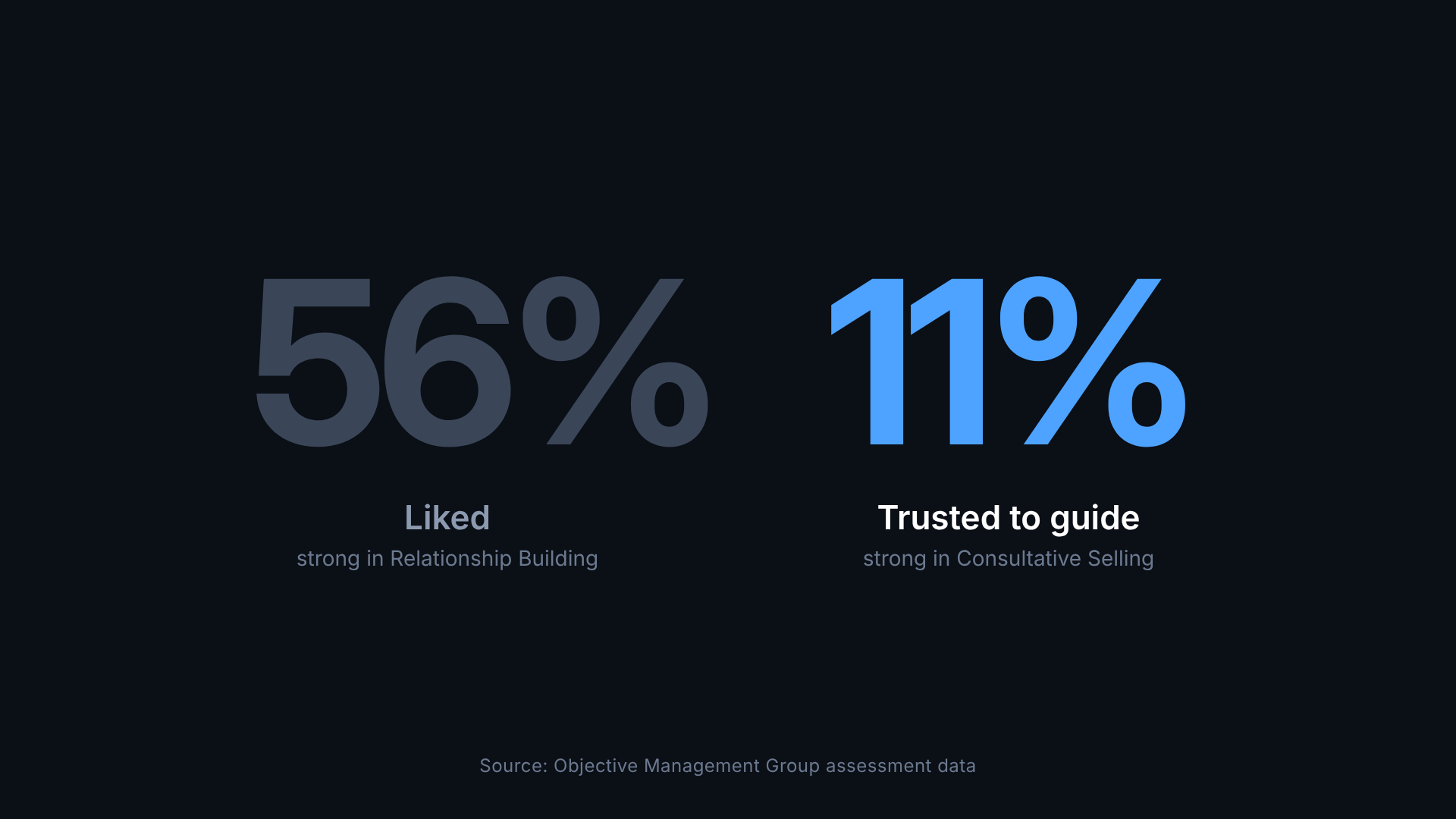
The research team at Objective Management Group (OMG) recently published an important analysis of why so few salespeople earn the trust of today’s B2B buyers. Their assessment data shows that whilst 56% of salespeople are strong in Relationship Building, only 11% are strong in Consultative Selling, which OMG defines as the ability to uncover the actual business issues and compelling reasons that will cause a prospect to buy. Many salespeople come across as likeable - but far fewer are trusted by buyers to guide their decisions.
I agree with the diagnosis - and I believe sales managers should be concerned about the issue it reveals. OMG’s evaluations are part of how I assess potential new hires and existing sales teams with my own clients, and the pattern they describe matches what I observe in far too many opportunity reviews: plenty of apparently friendly conversations, but far too few that actively change how the buyer thinks about their situation or advance their buying decision journey.
But there’s a further question worth asking. In which buying situations does this gap cost the most? Because the impact isn’t the same across every type of opportunity.
When “order taking” can be appropriate
Allow me to start by making a concession. Not every purchase needs a trusted advisor.
When a buyer has to renew a contract, replace something that has reached the end of its life, or buy more of something they already use and understand, the decision to act has largely already been made. They know what good looks like, they know how their organisation buys, and doing nothing is not a realistic option. What they need from a supplier is accuracy, speed and a fair price. In these circumstances, an efficient order taker can serve them well, and a self-service buying experience may serve them even better.
This may help explain Gartner’s finding that “67% of B2B buyers now prefer a rep-free experience”, up from 61% in its previous survey. Gartner doesn’t break these figures down by type of purchase, so I can’t use their data directly to prove the point I’m about to make. But I suspect a significant share of that preference relates to inevitable purchases where the buyer already knows the way.
The trouble starts when sellers, and their sales leaders, treat every purchase as if it were one of these - when the only decision to be made is what to buy, who to buy it from, and at what cost.
Discretionary purchases and unfamiliar buying decision journeys
The “trusted advisor” gap does the most damage when two conditions come together.
The first is that the purchase is discretionary. Nothing forces the buyer to act. There is no contract expiring, no regulation to comply with, no system that has stopped working. The customer could carry on as they are, and unless someone gives them a good reason not to, that is what happens most of the time. The status quo is often the most powerful “competitor”.
The second condition is that the buying decision journey is unfamiliar. The buyer, and most of their colleagues, haven’t bought anything like this before. They are entering unknown territory. They don’t know which questions to ask, who needs to be involved, what a sensible decision process looks like, or how to judge whether the outcome will be worth the investment and the risk of disruption.
Self-directed research is unlikely to provide all the answers. A web search or an AI tool can produce a list of vendors and a comparison of features. It won’t necessarily tell the buyer whether the problem is worth solving, what it is costing them to leave it alone, or how to persuade a sceptical finance director that this project deserves funding ahead of all the other projects competing for the same budget.
That’s why these types of buying journeys so often stall. Stakeholders struggle to reach consensus, any sense of urgency fades, and the project slips onto the “maybe next year” list. In my experience - and probably also yours - a decision to do nothing is now the most common reason why apparently well-qualified opportunities drop out of the pipeline at a late stage.
These are the types of buying decision journey where an “order taker” mindset has very little to offer, but where a salesperson with an advisor mindset who can help the buyer reach a confident decision can have a far greater impact.
Why sellers arrive too late
OMG’s article opens with a familiar scene: a prospect who agrees to a call only once the decision is mostly made. OMG reads this mainly as evidence of missing skills. But I think it’s also a matter of timing.
In a discretionary, unfamiliar purchase, the buying decision journey typically starts long before anyone has spoken to a salesperson. A trigger event, inside or outside the organisation, draws attention to an issue. Someone becomes concerned, does some initial research, and starts exploring the issue and its consequences. If a consensus begins to form, the potential customer moves on to defining which options to shortlist, who should be involved, what criteria to use and how the decision will be made.
Most of this happens internally. Buyers on an unfamiliar journey often don’t initially recognise that they could benefit from external help, so they rely on what they find online and what they hear from peers. Or they engage an external consultant, who is then asked to help shape the decision criteria.
By the time a salesperson is invited in, typically at the selecting phase, the problem has been framed, the requirements have been set, and the shortlist has been drawn up, often against criteria the seller had no chance to influence. And if the first sign of an opportunity is an unexpected RFP, the chances are that another vendor helped to shape it and you’ve been invited to make up the numbers.
By that late stage the only open question can appear to be “why us?” Even a salesperson with excellent consultative skills can find there is little left to diagnose unless they can reframe the underlying issue. They have been positioned as an order taker before the first active engagement.
Better hiring and training won’t fix that on their own. Salespeople who engage while the buyer is concerned, exploring or defining are far more likely to win, and those who engage around or before the trigger event that starts the journey tend to do better still. That calls for prospecting and marketing built around the business issues you solve and the trigger events that bring them to the surface, rather than around your product or service.
What allows a salesperson to earn that early involvement? It’s the ability to help with the questions the buyer can’t answer for themselves - and (this is the critically important element) the buyer’s belief that by engaging early they will learn something valuable that will improve their decision-making rather than be subjected to a crude sales pitch.
What buyers can’t work out for themselves
Outcome-Centric Selling® is built around four questions that every buyer needs convincing answers to before they will commit to action: why act, why now, why us and why trust.
Buyers who are engaged on a familiar journey can usually answer the first two for themselves. But in a discretionary, unfamiliar purchase they often can’t, and these are exactly the questions that self-directed research often leaves unanswered.
Why act? The buyer needs to understand the gap between their current situation and the better outcome they could achieve, and what it costs to leave that gap open. A good advisor can help them to see that the issues they already know about have a larger impact than they thought and introduce issues they hadn’t yet considered. An effective advisor also finds out what approaches the buyer might have already tried and what obstacles remain, because a buyer who sees no obvious obstacles is likely to conclude that they don’t need help.
Why now? Even a convinced buyer will delay if the decision does not seem urgent. An effective advisor can help the project sponsor to build an internal business case that links the project to the organisation’s priorities and makes the cost of delay explicit. This particularly matters when it comes to final approval, where someone in authority who hasn’t followed the details will often ask why this needs to happen now rather than next year.
This is close to how OMG defines Consultative Selling. Their 11% figure is, in effect, a measure of how few salespeople can help a buyer answer “why act” and “why now”.
Order takers tend to start with “why us”, because that’s the question they are most comfortable answering. But in a discretionary purchase, “why us” carries little weight until “why act” and “why now” have been settled in the buyer’s own terms - and the way they are settled also shapes the answer to “why trust”.
Why trust is earned, not claimed
Most salespeople try to address the “why trust” question at the end of the process, with customer references, case studies and logos. That evidence matters. But in a discretionary, unfamiliar purchase, the buyer has been forming a view of the salesperson’s trustworthiness from the very first conversation.
A salesperson who has helped the buyer clarify their thinking on “why act” and “why now” has already demonstrated things no reference can prove. They took the trouble to understand the buyer’s business before pitching their own. They were candid about the obstacles and prepared to say when a project didn’t yet stack up. And they helped the project sponsor build a business case strong enough to survive final approval.
That last point is easily overlooked. The sponsor’s own reputation is often closely tied to the project. A salesperson who has helped make the case for change as robust as possible has protected the sponsor in front of their colleagues, and that is a far stronger foundation for trust than merely being pleasant to deal with. It also makes “why us” more credible, because differentiation framed around an outcome the buyer has already defined carries far more weight than a list of features.
Gartner’s research shows why this matters: confident buyers are twice as likely to report a high-quality deal as buyers with low decision confidence. And as Matt Dixon and Ted McKenna argue in The JOLT Effect, buyers late in their journey worry less about missing out than about making a decision they’ll regret. Trust is what reduces that fear.
The strongest trust signal of all is a willingness to share accountability for the result. A mutual success plan that works backwards from the buyer’s intended outcome shows that the seller’s commitment doesn’t end when the order is signed. I’ll look at how to build mutual success plans in a future article.
What this means for sales leaders
OMG’s assessments can tell you how many of your salespeople have the skills to act as advisors, and I strongly recommend that you implement their approach in your own organisation. But then I’d add two more questions.
- First, where in the buying decision journey are your salespeople first meeting buyers on discretionary deals? If the honest answer is typically “at the selecting phase”, better skills alone won’t change your win rate
- Second, can your salespeople help buyers answer “why act” and “why now”, in the buyer’s own terms and with the buyer’s own numbers? If they can’t, they’ll keep competing on “why us”, and on price. And as a result, they will lose too many deals they could have won, and give away too much avoidable discount on the deals they actually do win
If you’d like to explore how Outcome-Centric Selling® approaches these questions, you can download my eBook, Mastering Outcome-Centric Selling®, here.

Comments