


Understanding your customer's buying decision journey

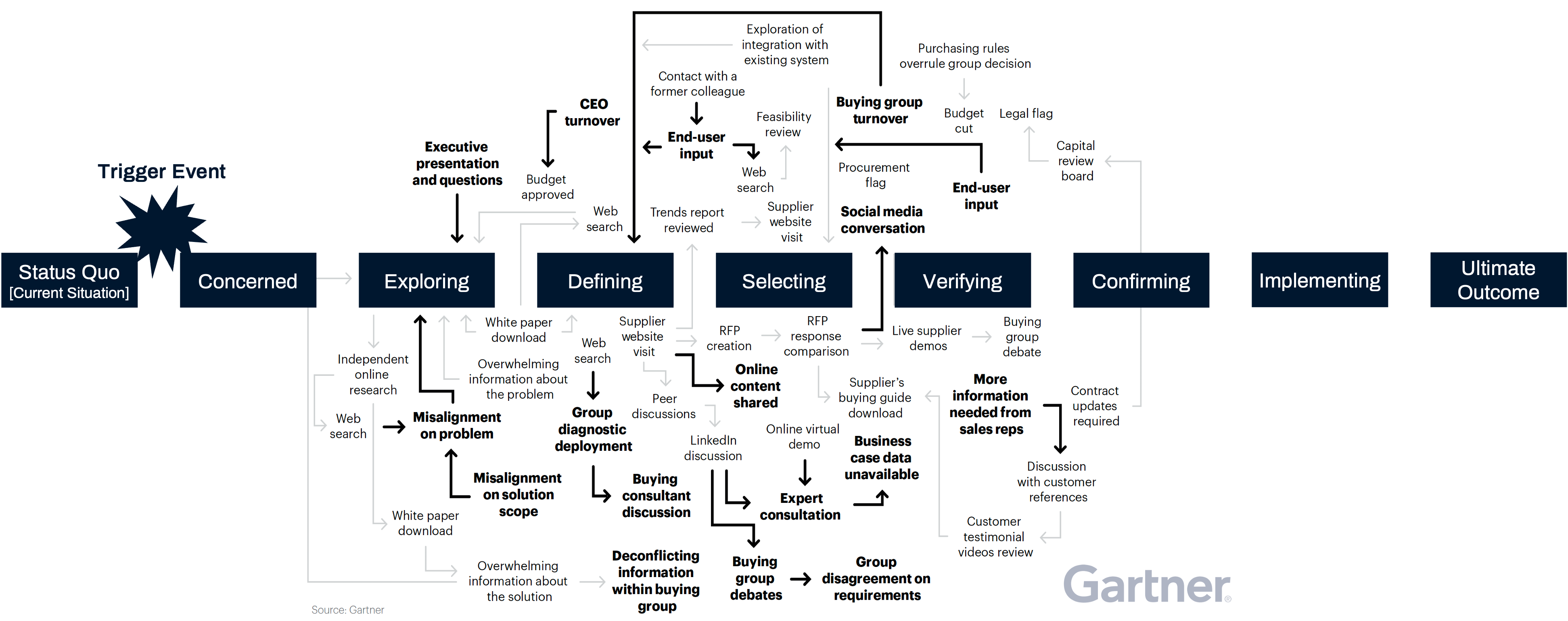
 It’s falsely comforting to think of selling as a process in which one step follows logically after another - but this completely fails to reflect the reality of any even moderately complicated B2B sales environment.
The truth of the matter is that in complex B2B sales your customer’s buying journeys are rarely linear, compounded by the fact that they are sometimes poorly defined or even if they are well defined are often not well understood by many of your customer's decision-making team. This is particularly true if the customer is entering unfamiliar territory, and trying to buy something they have not successfully purchased previously
Rather than following a perfectly straight path, these customer decision journeys often zig and zag, go backwards as well as forwards, find themselves way off-piste, struggle to achieve consensus, can be redirected on the whim of a single powerful individual or can be abandoned at any stage along the way.
Gartner characterised this "long, hard slog" as looking more like a spaghetti bowl than a conveniently linear process ...
There is no magic wand, but there are a few things your sales people can do. The first is to accept that for any significant unfamiliar purchases, your customer’s decision-making journeys are inherently complex. The second is to accept that they will probably never achieve anything close to perfect knowledge.
And the third is to recognise that very few significant decisions are made by a single individual without reference to or regard for a wider decision group. The latest research suggests that the average decision group now involves 10-11 active stakeholders in high-value, complex and significant projects - sometimes less, but often more.
Despite all these challenges, salespeople can and must do their best to avoid being blind-sided by factors that they ought to be able to predict are likely to come into play. Rather than blindly following a rigid, linear “sales process”, your salespeople need to diagnose where their customer is in their decision making journey and adapt their strategies accordingly.
As you’ve undoubtedly observed, this can change at any time and without notice. Some members of the customer's decision group may be ahead of the curve, and some behind. It’s particularly important that your salespeople aren’t deceived by one over-enthusiastic champion into thinking that the group as a whole are further advanced than they really are.
That having been said, at any given point in time the centre of gravity of your prospective customer’s decision journey is likely to be in one of the following phases:
Status Quo - Unconcerned
While in this phase the potential customer is - by and large - currently unconcerned about any of the issues you might have chosen to target and is not yet engaged in any form of active buying decision journey. However, they are still likely to be monitoring key trends that they see as relevant to their industry, organisation or role.
This is the state which most of your future customers find themselves in most of the time. Your sales and marketing team's role in this phase of their journey is to educate and inform the key influencers in your key target customers by offering genuine thought leadership and insights that serve to shape their perspectives and influence their thinking.
Concerned
Something - usually the result of a powerful disruptive force or a significant trigger event - now disturbs the status quo and draws your customer’s attention to a potentially significant challenge, opportunity or threat. They are now trying to establish the likely impact of the issue, what remedies might be available, and whether there might be a business reason to act.
Your sales, marketing and business development team's role in this phase of their journey is to monitor these disruptive forces and trigger events, to articulate a distinctive point of view, to be seen as a source of accessible and credible expertise, and to proactively reach out to the affected people and organisations.
Exploring
Having identified the challenge, and having concluded that the issue is worth investigating in greater detail, your potential customer will typically now engage with other members of their organisation, research trusted sources of information, and try and establish what credible solutions might be available - drawing up a list of potential options.
Your sales, marketing and business development team's role in this phase of their journey is to encourage your prospective customer to consume your thought leadership content, to position your organisation as a credible option, to leave them wanting to know more, and to persuade them to engage with a salesperson sooner rather than later.
Defining
Having concluded that credible solutions are available, your prospective customer now turns their attention to shortlisting their most promising options, establishing their vision of a solution and defining their decision criteria, decision group and timeframe.
It is critically important that your salespeople actively engage the customer before or during this phase - prior to their issuing a formal tender or RFP document, after which it is often too late to reshape the customer’s thinking. If they do this effectively, they will dramatically increase their chances of winning the customer's business.
Selecting
The customer's decision group is now evaluating the pros-and-cons of their shortlisted options, further refining the business case and seeking to identify their preferred option - which if the business case is not strong enough and if the stakeholders fail to achieve consensus is likely to be a decision to “do nothing”.
In addition to promoting the merits of your proposed solution and establishing the business case, your salespeople's role during this pivotal phase is to ensure that all stakeholders see the distinct differences and advantages of your approach from their individual perspectives.
Verifying
The customer's decision group is now seeking to verify their choice, to negotiate the best possible terms, to eliminate any remaining reservations and to secure the support of their colleagues for the project. Even though you might have been selected, you are by no means guaranteed the customer’s business.
This is not just about securing the best deal - it is also about diagnosing and dealing with any and all perceived risks or concerns that are associated with either the project itself, the chosen vendor and the chosen solution.
Confirming
The project and its associated business justification is now being submitted to the ultimate decision authority for final approval - and often finds itself competing for funding and senior management attention against other investment opportunities.
Your salespeople may have eliminated all your other competitors as far as this project is concerned - but they also need to make sure that their project’s business case and executive sponsorship is strong enough for it to emerge at the top of the customer’s list of spending priorities. If they fail to pay due attention to this, there's a significant risk that the project will fall at this final hurdle.
Consensus building and validation
Regardless of which phase or phases the customer's decision group are currently in, there are two connected parallel processes that are essential foundations for making tangible progress, and they are consensus building and validation.
If there is no consensus across the decision group about whether the problem is real, what needs to be done about it and what the best option is, they are likely to stick with the status quo and do nothing. And the same outcome is likely until and unless the vendor's claims have been validated.
This crucial need for consensus building and validation is why successful projects tend to have strong internal leaders - the "Challenger Customer" book referred to these people as Mobilisers® - who are capable of leading their colleagues on the decision group towards a common consensus.
After the "sale" is complete
You might think that your "sales process" is over when you book your customer's order. But of course their buying decision journey isn't over until they have successfully implemented the solution you have sold them, and they agree that they have achieved the business outcomes that they sought.
If - like a growing number of "as-a-service" business transactions - you expect to renew or expand your presence in the customer over time, you need to ensure that every significant stakeholder within your customer believes and acknowledges that these business outcomes have been fully achieved and preferably exceeded.
In Conclusion
The above buying journey phase descriptions are inevitably somewhat idealised. It is entirely possible that some projects rush through or skip some of these phases altogether. As we’ve already identified, the customer's decision journey can stall, go into reverse or go forwards. But when key phases are not completed to at least a minimum level - for example, clearly defining their requirements, decision criteria and process - it is far more likely that the journey will subsequently fail.
Your sales people can’t hope to know where their customer is on their journey unless they observe their behaviour closely for the relevant indicators. And they can’t assume that their next step will be forwards. But they can facilitate that movement by eliminating anything which is under their control or influence that could otherwise hold the customer back.
And that, of course, is exactly what our Outcome-Centric Selling® System has been designed to do. Let's set up a call if you'd like to learn more.
By the way, I wrote the first version of this article back in 2019. It's both striking and comforting to see how much of the original thinking remains relevant today.
Comments