


Making Every Conversation Count


A Framework for Value-Creating Sales Conversations
In complex B2B sales environments, customers report that fewer than one in five conversations with salespeople prove to be a valuable use of their time. This harsh reality should concern every B2B sales professional - perhaps it is no wonder that it is becoming increasingly hard to persuade prospects to talk to salespeople!
The Four Possible Outcomes
Every customer conversation has four potential outcomes: an advance, a continuation, a halt, or a disqualification. Top-performing salespeople are far more likely to achieve advances or to disqualify quickly. Their less effective colleagues generate endless continuations and halts - activity without progress. The difference? Planning and preparation.
Neil Rackham, author of SPIN Selling, said that: "Good selling depends on good planning more than any other single factor." Yet far too many salespeople are still winging it, relying on charm and improvisation rather than proper preparation. In a world that involves multiple stakeholders, numerous conversations, and a reluctance to commit, this sort of slapdash behaviour must surely be unacceptable.
The Conversational “Layer Cake”
The following five-layer structure can ensure that every conversation delivers value for every participant.
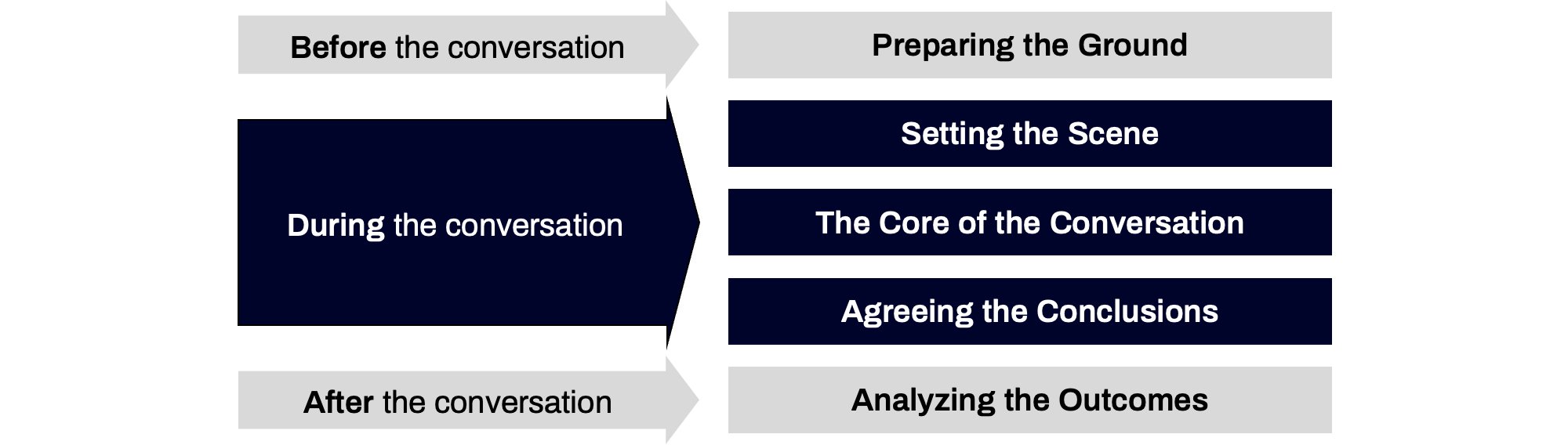
1: Before the Conversation - Preparing the Ground
Sound foundations require research, SMART objectives, and logistics. This includes profiling the organization against your ideal customer profile, reviewing the participants' LinkedIn profiles, identifying their strategic priorities, and understanding what triggered their willingness to engage in the first place.
It is equally important to establish specific, measurable objectives for the conversation. These objectives must address what you want to achieve, what your customer wants from the conversation, and how both you and they will judge success. Without this clarity, the chances of failure are very high.
2: Opening - Setting the Scene
The first few minutes set the tone for the rest of the conversation. This is where you must confirm the participant’s goals, agree a shared purpose, confirm the agenda and timing, and - critically - establish a provisional next step.
The provisional next step is a particularly powerful tactic. Before diving into the core of the conversation, you need to agree what will happen next if the meeting objectives are met by asking: "Assuming we successfully accomplish these objectives, would it be reasonable to agree that our next step should be to schedule [your desired next step]?" This simple approach dramatically increases the likelihood of achieving a meaningful advance.
3: The Core of the Conversation
The following elements should be interwoven throughout the conversation: teach, learn, share, and anticipate.
Teach: Share insights that cause your customer to think differently. Your insights should challenge assumptions, highlight unconsidered implications, or introduce fresh perspectives from authoritative sources. Executives regard relevant business insights as four times more valuable than product information.
Learn: Ask questions that advance understanding for both parties. Use SPIN-Cycle questioning to progress from situation to problem to implication to value. But you must avoid interrogations. Customers deeply resent boring streams of qualifying questions that benefit only you - balance is essential.
Share: Tell stories that allow customers to learn from others' experiences. A well-structured anecdote about a similar role in a similar organization facing similar challenges carries more credibility than any claim you might make. Realistic stories that progress from situation through complications and turning points to resolution are particularly persuasive.
Anticipate: You must prepare for predictable questions, “objections” and concerns. Collaborate with your colleagues to develop effective responses. Practice delivering them in a way that seems natural - you must never sound over-rehearsed or defensive.
Throughout the core of the conversation, you must maintain a "give-get balance" in which every participant must emerge believing they learned something valuable - this is how preparation transforms good salespeople into great ones.
4: Closing: Agreeing Conclusions
Make sure you set aside sufficient time to summarize, reconfirm the provisional next step you established earlier, and agree additional actions. Every action requires a clear task, owner, and completion date. Vague commitments like "we'll try to set something up" must be avoided. Strong commitments include words like "will" and "must," not "hope" or "try."
5: After the Conversation: Analysing the Outcomes
If the conversation was worth planning, it's worth learning from. Reflect on what you achieved, what you learned, and how it affects your qualification and strategy. Did you achieve your SMART objectives? Did the customer confirm the provisional next step? What lessons do you need to learn?
From Theory to Practice
Some might think this framework appears rigid or time-consuming, but it becomes intuitive with practice. A few minutes of targeted research prevents wasting hours in poorly prepared meetings. Having a clear plan doesn't restrict you - it frees you to listen actively and adapt to what you hear.
The alternative to planning is an addiction to Hopium. Hope that something useful emerges from the conversation. Hope that momentum continues. Hope that your pipeline converts. Top performers don't rely on hope. They succeed through preparation, clear objectives, and systematic follow-through.
In complex B2B sales, you rarely get second chances with senior stakeholders. Every conversation must contribute. The five-layer framework ensures it does - by creating genuine value for your customer while advancing your sales process. When both parties end a conversation having learned something valuable and with clear next steps, you've achieved something rare: a meeting that was actually worth everyone's time.
This article was originally published in the March 2026 edition of Top Sales Magazine.
Bob Apollo is Chief Outcomes Officer at Inflexion-Point Strategy Partners and is the driving force behind the Outcome-Centric Selling® Academy: find out more by visiting https://academy.inflexion-point.com.

Comments