


Your sales process is organised around your funnel. Your buyer’s decision isn’t.

Post by
Bob Apollo
November 9, 2026
November 9, 2026
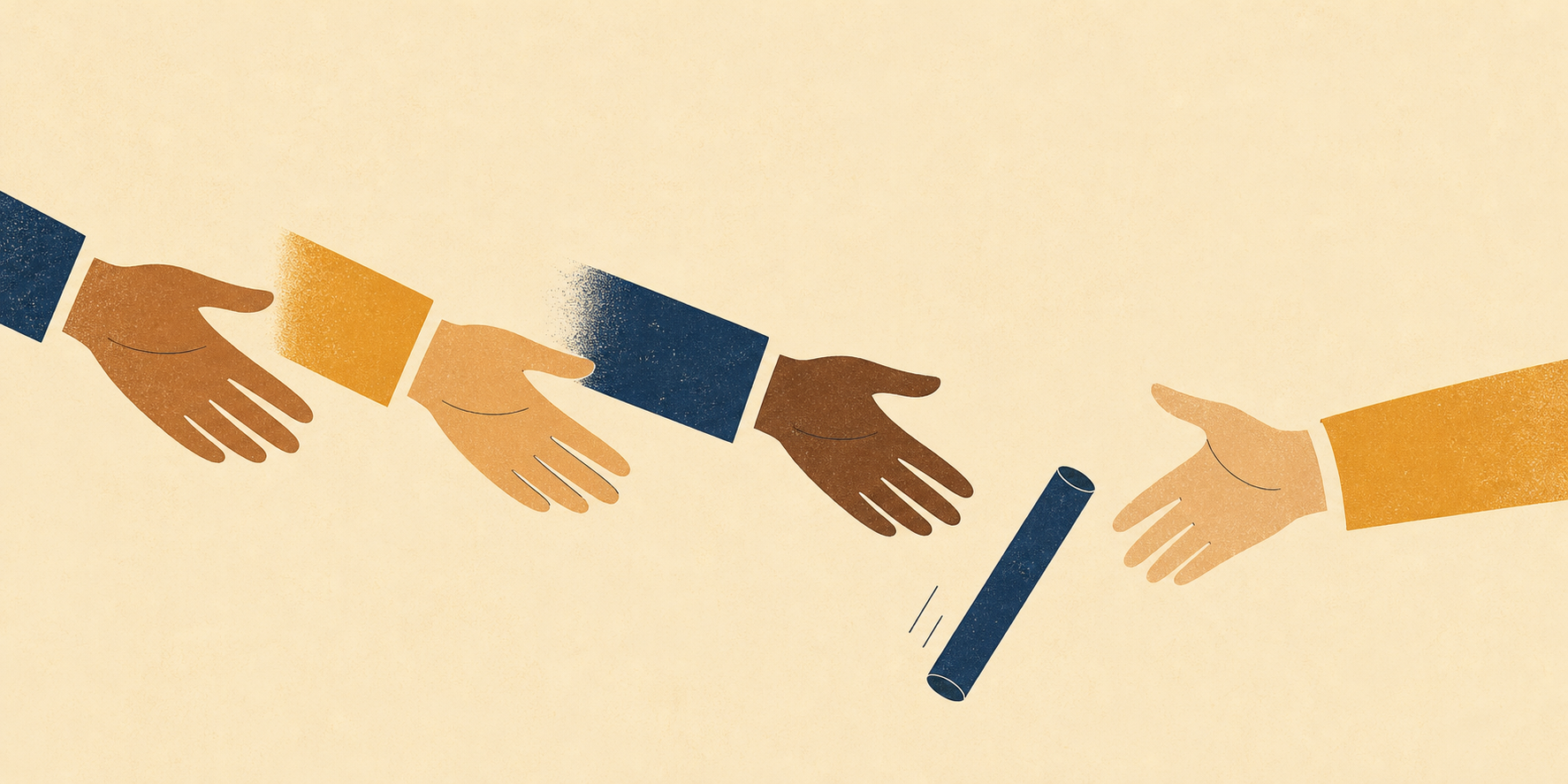
In my last article, I suggested that sales leaders should ask where the handoffs in their sales process are diluting the outcome story their buyer needs to hear. This is my attempt to answer that question, and it starts with an idea from the McKinsey Quarterly article that prompted the last piece.
McKinsey argues that AI calls for a shift from the org chart to what they call the orchestration chart. Companies have traditionally organised people into functions and hierarchies, with work passing from one part of the organisation to another. AI makes a different logic possible: “Start with the outcome, then assemble the humans and agents needed to deliver it.” McKinsey’s research found that the companies furthest along in AI reinvention are more likely to organise cross-functional teams around end-to-end products, customer journeys and business processes.
Most B2B sales organisations are still built the other way round. They’re organised around the sales funnel, and the customer is often passed from one specialist to the next as the deal moves through its stages. In complex, discretionary and unfamiliar buying decisions, the limitations of that approach cost more than most sales leaders realise, and the lost value keeps growing after the order is booked.
How we got here
The sequential specialist model has a lot in common with Taylorist scientific management. Break the work into stages, give each stage to a specialist, measure each specialist on their own output, and hand the work on. SDRs generate meetings. Account executives run opportunities. Solutions engineers handle the technical case. Customer success takes over once the order is booked.
For high-volume, familiar purchases, this can work reasonably well. The buyer knows what they want, the stages are predictable, and not much needs to be carried from one step to the next.
But complex, discretionary decisions are very different. The buyer rarely moves through an orderly and precisely predetermined sequence. Stakeholders join late, priorities shift, and questions that seemed settled get reopened. The most important conversations often happen early, when the buyer is still working out whether there is a problem worth solving, and that is exactly where the specialist model tends to place its least experienced people. An SDR measured on meetings booked is rarely equipped for the kind of exploratory discussion an unfamiliar buying decision needs.
What gets lost at each handoff
The four questions at the heart of Outcome-Centric Selling® (why act, why now, why us and why trust) offer a useful way to see what each handoff costs.
When the SDR hands over to the account executive, “why act” often arrives as a pain point identified to secure a meeting, rather than an outcome the buyer has started to commit to. The account executive either starts again or builds on a weak foundation.
When the solutions engineer joins, the conversation tends to move towards capabilities. “Why us” begins to crowd out “why act”, and the buyer’s reasons for changing often get less attention than the features of the solution.
The handoff to customer success is often the most damaging. The order has been booked, and a new team arrives with a new set of questions. Some were asked by the salesperson, who never recorded or shared the answers. Others should have been asked during the sale but weren’t. Either way, the customer is often asked to repeat themselves at the moment they expected the supplier to start delivering on its promises.
The result is frustration, and it undermines “why trust” just as the relationship moves from selling to delivering. A buyer who has just taken a career risk on an unfamiliar decision is entitled to wonder whether the supplier was listening (and how much they really care about the buyer’s success).
Who owns the customer after the sale?
The repeated questions are a symptom of a bigger problem. In many organisations, nobody owns the commercial relationship as a whole once the order is booked. Customer success looks after adoption, account management looks for expansion, and a renewals team may handle the renewal. Each sees part of the customer. None of them carries the outcome the buyer actually thought they were buying.
A recent Winning by Design executive brief by Jacco van der Kooij and David Gordillo, From 10X Engineer to 3X Seller, argues that this fragmentation has become a serious commercial problem. When customers pay for the impact a solution delivers, rather than for the software itself, the sale doesn’t end at the signature. More of the growth comes after the first sale, which exposes what the authors call the SaaS model’s weak spot: expansion, split across the account executive, customer success and account management. They also point out that since 2022, the growth rate of B2B software companies has fallen from 55 percent to 20 percent, while retention has slipped from 76 percent to 70 percent.
In complex, discretionary decisions, the stakes are higher still. The promised outcome usually takes months to realise, and renewal and expansion revenue depends on it. If the person who understood why the customer bought has moved on to the next deal, the supplier is managing its most valuable relationships with the least context or continuity.
The case for fewer, broader roles
In complex, discretionary and unfamiliar buying environments, I believe there is a strong argument for abandoning sequential specialisation altogether, or at least for keeping it to a minimum. The buyer is better served by one primary salesperson who owns their outcome from the first exploratory conversation through to the point where value is being realised, and on through renewal and expansion.
The traditional objection is capacity. A senior salesperson can’t research every account, prospect at volume, prepare every meeting, document every conversation and coordinate every internal resource. Specialisation was partly a response to that constraint.
AI changes the calculation. Agents can now take on much of the research, preparation, documentation, follow-up and internal coordination that used to justify splitting the role. That frees the primary salesperson to spend more of their time on what only they can do: exploring the buyer’s situation, helping the buying group build a shared case for change, and earning the trust that unfamiliar decisions depend on.
Winning by Design calls this the full-cycle seller: one seller who directs AI agents across the whole customer lifecycle, staying with customers after the close and remaining accountable for the impact they bought. Because the seller retains responsibility for renewal and expansion, they own and drive multiple years’ worth of customer value rather than just the value of the first order.
The authors acknowledge that their assumption that seller-owned accounts retain better than handed-off ones is a hypothesis consistent with field observation, not yet a measured result. In complex, discretionary sales, I find the logic persuasive.
Specialists still have a place. Some technical and implementation questions need deep expertise. But in this model specialists join the team around the buyer’s outcome when they’re needed. They don’t take ownership of the relationship, and the buyer doesn’t have to start again each time a new face appears.
What AI changes, and what it doesn’t
There’s a trap here, though. AI is just as capable of making the old handoffs run more smoothly. Automated call summaries and handover notes can reduce the friction at each step without anyone asking whether the step should exist at all.
Passing information on is not the same as owning the outcome. A summary can tell customer success what the buyer said. It can’t carry the understanding, commitment and trust built up during the sale. McKinsey makes the point in a broader context, warning that a flatter structure “can enable value only if the lost coordination is replaced by better intelligence, clearer decision rights, and stronger human judgment.”
This has significant implications for the qualities sales organisations should look for. Tomorrow’s top performers will need to combine the ability to get the most from artificial intelligence with high levels of emotional intelligence and strong customer communication skills. That will change how salespeople are recruited and developed, and some of today’s high performers may struggle with the transition.
There is one more obstacle, which I’ll return to in a future article. Many sales compensation plans reward the account executive at signature and measure customer success on renewal. Traditionally, nobody is rewarded for achieving the outcome the buyer actually thought they were buying. Winning by Design is explicit that full-cycle selling works only if the organisation lets go of the handoff, and that this “takes a new comp plan, a new org structure, and new hiring profiles.” Until that changes, handoffs will persist, because each role is measured and paid on finishing its stage and passing the customer on.
A practical test
Here’s a suggestion:
Take one recent deal you won and one you lost. Count the handoffs. For each deal, write down the outcome the buyer described in the first serious conversation, the outcome your team was talking about at signature, and (for the win) what customer success was measuring three months later. If those three descriptions don’t match, you’ve found where your process is costing you. Finally, ask who owns that customer’s renewal and expansion today, and how much of the original story they know.
Then sketch the team you would design for that deal if you were starting from the buyer’s outcome rather than your funnel. Which roles would you keep? What would agents do? Where would human judgement matter most?
If you reduce handoffs and broaden roles, one question becomes harder to avoid. If agents take over the groundwork that junior sellers used to learn from, where will the next generation of primary salespeople develop their judgement? That question deserves far more attention than it is currently getting. I don’t have a perfect answer, but I sense that it’s something worth exploring in a future article.
What do you think? Do these issues seem real to you? And how do you think your organisation needs to address them? Please share your thoughts.
I want to acknowledge the help and support of my colleague Claude in writing this article. But the brief was mine, the final edits were mine, and I own the conclusions.
Outcome-Centric Selling® was designed for complex, discretionary decisions in which buyers are travelling an unfamiliar path. You can download the Mastering Outcome-Centric Selling® eBook here

Comments