Get in touch...

Bob Apollo
 
CustomerThink Top25

Follow me...

Follow bobapollo on Twitter

Subscribe to blog...

Your email:

Our favourite Dilberts

Dilbert

Are you REALLY Customer-Aligned?

Checklist Download

Latest white paper...

How and why

Reflexion-Points...

Current Articles | RSS Feed RSS Feed

McKinsey: Shooting holes in the "Sales Funnel"

 | Submit to Digg digg it | Add to delicious delicious | Share on Facebook Facebook | Share on Twitter Twitter | Share on LinkedIn LinkedIn 


The latest McKinsey Quarterly carries a great article on the consumer decision journey - and shoots holes in the now outdated “sales funnel” metaphor.  Whilst the piece focuses primarily on B2C buyer behaviour, our own observations suggest that many of the principles are equally relevant to the process of B2B buying.

The authors explain that the linear process concept implied by the “sales funnel” – although attractively (and deceptively) simple – no longer reflects the complexities of today’s customer decision journeys.  It fails to capture the many touch points and two-way interactions that are a consequence of an increasingly well-informed, networked and discerning prospect community.

Ease of access to internet information, and the increasing importance of word of mouth, recommendation and reputation in the B2B buying process has transferred information power into the hands of the prospect.  It’s no longer unusual for the group of potential solutions being considered to expand, rather than narrow, at some stage in the decision journey before the choice of what (or if) to buy is made.

Trigger Events

McKinsey highlight the importance of trigger events – something we’ve written about before – that kick-start the customer decision journey in the first place.  As we’ve pointed out, in the world of B2B, these trigger events can be internal to the organisation (such changes in staff, responsibilities or circumstances) or external to the market (such as major changes in technology, legislation or the balance of competition).

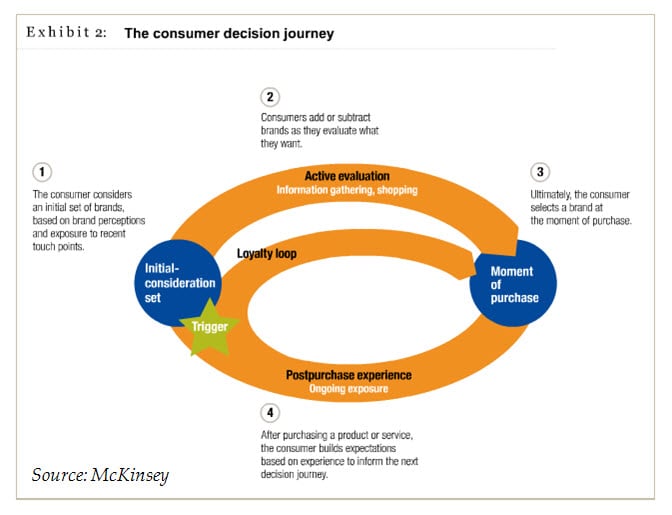
At first the prospective buyer may either be unaware or unconcerned – but then something happens (the trigger event) to raise their awareness that they have an issue that they need to deal with – and the search for a solution gets underway.  McKinsey see the B2C process as a circular, rather than a linear journey, with four potential battlegrounds where marketers can win or lose: initial consideration, active evaluation, closure through purchase, and post-purchase.

McKinsey Customer Decision Journey

These are closely analogous to the four key stages we have identified in the B2B customer decision journey: get connected, get considered, get chosen and get recommended.  McKinsey point out that once they have defined an initial vendor consideration set, consumers then tend “shop a category” which may result in additional vendors being included in their evaluation – exactly the behaviour we have observed in B2B, and highlighting the critical importance of being found in the right categories when prospects start searching for solutions.

At each stage in their respective buying processes, both B2C and B2B customers face the choice of continuing, pausing or abandoning their decision-making journey, and adding, continuing with or subtracting vendors from consideration.  Prospects of both types seem to have a strong preference for “pulling” the information they need to make these decisions rather than having it pushed at them by vendors, and to place greater trust in third party validation than in vendor messaging.

B2Both

So, although the McKinsey survey focused only on B2C behaviour, we should not be surprised to observe similar things happening in B2C, or to find that McKinsey’s recommendation – that vendors align their marketing efforts with the customer decision journey – are equally relevant to the world of B2B sales and marketing.

We’ll be publishing a series of connected blogs over the coming weeks, but I’m interested in your perspective – what can we as B2B marketers learn from this study?  What other parallels have you observed?

About Us

Inflexion-Point Strategy Partners are B2B Sales and Marketing consultants with a systematic, evidence-driven approach to improving sales and marketing performance.   To find out more, please browse our site and when you are ready, please call us on +44 (0)845 519 0295 or contact us here.


Comments

Thanks for posting this Bob. I congratulate McKinsey on trying to reinvent the wheel, or funnel, but I'm not sold.  
 
While their argument should help sink the idea of the "sales funnel", it doesn't diminish the idea of the buyer's journey, which you alertly pointed out. 
 
Essentially the buyer's journey is linear with detours along the way. Perhaps a better metaphor is a vertical cork screw. 
 
Smart marketers are aware that when a buyer stalls at a certain stage they need to be recycled back to another point in the funnel and nurtured. This is circular in nature. 
 
Smart marketers have also figured out that today's buyer (B2C and B2B) prefer to reach for information. It's the marketer's job to make the right information available at the right place at the right time. 
 
Cheers 
Chuck Besondy, Funnel Coach and Interim Marketing Exec
Posted @ Wednesday, August 12, 2009 2:10 PM by Charles Besondy
Good post Bob.  
 
There are many parallels between the worlds of B2C and B2B, but we have to be careful about which we try to adapt. The most striking difference is the complexity of the buying and selling process. 
 
Certainly there are complex purchases we make as consumers and simple ones that business make, but in the main the difference bwteeen B2B and B2C is what many characterise as "complex sales environment". As we are talking of buyer behaviour here, perhaps we'd be better-served by calling it "complex buying environment". 
 
Businesses are not immunne to the power of business brands. The oft-used (but now out-dated) "no-one ever got fired for buying IBM" still holds for many business brands. It also works against the seller if not managed well.  
 
Our decision to engage with a seller - or enter their funnel - is often built on thought processes similar to those of the world of B2C. The 'trigger event' described in the McKinsey article is certainly a parallel. As an example, readers of our thought-leadership articles will often read and do nothing for years, and then suddenly act. Is this a flaw in our call-to-action, or is it that something changed in their business and now they are ready? It could be something in the article grabbed their attention to address a latent issue, or that their world changed somehow. 
 
So far, we are completely aligned to the notion of the circular behaviour of buyers and a 'trigger event'. This is what Chuck was alluding to in reference to the 'corkscrew'. Seller: do something to position, remain positioned, progressively and subtly change thei rconcept, try to trigger a new thought and some action, but whatever you do, be there for the buyer when their world changes all on its own. 
 
But then it changes. When business makes a complex decision, their are distinct stages they go through (some cognitive, others procedural), and the seller's job is to manage them through each stage. At each stage, some will leak from the funnel. Seller: get them back onto your rhythmic corkscrew tactics, and get them back into a new dialogue ASAP. Many at the first few stages, few at the bottom. Sounds like a funnel to me.  
 
The science of funnel management can benefit from selectively adopting great ideas from the world of consumer marketing. McKinsey have certainly made a contribution. And thanks to Bob for raising. But shoot holes in the funnel? The holes were already there. McKinsey have merely observed what many sellers around the world have known since the dawn of time.  
 
The funnel leaks.
Posted @ Friday, August 14, 2009 5:43 PM by Hugh Macfarlane
Does anyone else see a clear link with Nudge principles here? ... where can we bring behavioural economics into play at these key touchpoints?
Posted @ Wednesday, August 19, 2009 12:01 PM by Rob Barnes
The principles in "Nudge" by Thaler and Sunstein can certainly be applied to the goal of facilitating your prospect's buying process. The goal of the vendor should be to make it easier for their prospect to make appropriate choices at each stage in their buying process.
Posted @ Thursday, August 20, 2009 1:31 AM by Bob Apollo
Great article, thanks for the insight. It's clear that the traditional purchase funnel needs to evolve fast to keep up with internet technology. Some businesses have been too slow to update their behaviours and are suffering as a result. The internet will continue to challenge the marketing paradigm for years to come and eventually the industry will catch up! 
 
The purchase funnel
Posted @ Saturday, September 05, 2009 5:03 AM by Tim
Post Comment
Name
 *
Email
 *
Website (optional)
Comment
 *

Allowed tags: <a> link, <b> bold, <i> italics

Receive email when someone replies.