


Does your sales pipeline need a massive clean-up operation?

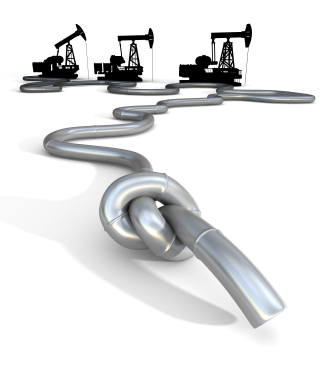 BP has been getting a great deal of adverse publicity for the recent massive leak in their Gulf of Mexico oil pipeline. It’s taken an age to address the underlying problem. The clean-up operation is clearly going to take ages and cost billions. The fortunes of the Bubba Gump shrimp company and many others like it may never recover.
Those of us who manage sales pipelines know that they rarely run freely. Many are clogged with deals that are going nowhere and which only serve to slow the progress of more promising opportunities.
But slow-moving pipelines aren’t the only problem. Sales pipelines also leak, as prospects either decide to buy something else or do nothing. Worst of all, many deals leak late in the process – towards the end of the pipeline - after huge amounts of sales effort have been applied.
My observations of high-value B2B sales suggest that clogged and leaky sales pipelines are often the norm and that much of the effort that sales teams expend on trying to move deals forward is wasted. So it’s no surprise that CSO Insight’s annual report on sales performance optimisation has recorded some of the lowest sales win rates on record.
It’s time for a massive clean-up operation – let’s just hope we can do better than BP. But what is it going to take?
Clearly define the key stages in your sales pipeline
Let’s start with the basics. Your pipeline stages must be clearly defined, consistently applied, and reflect meaningful steps in your prospect’s decision making process. The progress of each opportunity must be based on observable evidence of your prospect’s behaviour and intent, and not just on your sales activities. These are the essential foundations for any successful sales pipeline clean-up operation.
Carefully measure flow and leakage
Once you’re sure that the contents of your sales pipeline are being reported accurately, your attention should turn to measuring flow and leakage. Flow is about measuring how long it takes for successful deals to pass from one stage to the next in the pipeline, and using this as a benchmark to identify deals that have been “stuck in stage” for too long. This is important because of one simple fact: it inevitably takes you longer to lose a deal (or recognise it is lost) than it does to win.
Leakage is the other key metric. At what stage do deals fall out of the pipeline, and what is the real percentage of deals that ultimately convert to wins from each stage? I use the phrase “real percentage” deliberately. More often than not, CRM systems apply percentages to stages that have no relationship to reality, have never been reviewed or adjusted, and are precisely and dangerously wrong. It’s no wonder that average forecast accuracy rates (as measured by whether deals close as predicted) is now below 50%. If you’re still using the percentages that came out of the box with your CRM system – or if you haven’t reviewed them against reality recently, deal with it now. You can’t afford to wait.
Establish benchmarks
Once you have good underlying data and good metrics, you can establish benchmarks and start comparing the performance of your sales team members. Look at recent sales successes. Establish the cadence of their progress from stage to stage. Set deal flow benchmarks. Isolate deals that are taking longer than these winning benchmarks, and carefully re-qualify them to make sure they are real. If not, remove them from the pipeline. Review your sales strategy for deals that still seem promising but are stuck in stage. What can you do to help the prospect move forward to the next stage with you?
Look at the shape of your sales team’s pipelines. Are they qualifying out early, or losing late? Winning sales people seem to follow a consistent pattern – they take time over qualifying, qualify more deals out early in the pipeline, and successfully close the remaining opportunities faster than their also-ran peers. Conversely, average sales performers often have a habit of “losing late” – deals are either lost or qualified out late in the journey, after huge levels of effort have been wasted. You need to understand why, and take remedial action to help them embrace the winning behaviours of your top performers. But most important, if you’re going to lose, lose early!
Qualification should be a continuous process
Another common reason for opportunities getting stuck in the middle of the sales pipeline is that the prospect’s circumstances have changed. Even if the deal appeared well qualified initially, something’s happened – maybe the prospect now has other priorities – and progress has stalled.
Qualification is not and cannot be a one-time event. In fact, I recommend that at each stage in the sales pipeline that you identify and assess key qualifiers that are relevant to that stage in the buying process and which can alert you to these changing circumstances and either give you the chance to react to them or to qualify out before any further sales effort is wasted.
Avoid putting rubbish in your pipeline in the first place
My final recommendation is to avoid filling the pipeline with rubbish in the first place. Make sure that you establish “ideal prospect” profile, target your marketing towards them, and qualify inbound enquiries against them. Be careful to distinguish between interesting, important and urgent needs, and ensure that you are working on opportunities where the problem is already urgent or can be elevated to an urgent need.
Resist the temptation to add more poorly qualified prospects to the pipeline – you’ll only make matters worse, and have an even more expensive clean-up operation to perform later on. Focus on managing quality, velocity and leakage and encouraging winning behaviour, and you’ll have the foundation for a smoothly flowing sales pipeline. And by eliminating all that wasted effort, you’ll be doing your bit for the environment as well!

Comments