Subscribe to this Blog

Your email:

B2B Sales and Marketing Alignment

 CustomerThink Logo

OpenView Labs Top 25

Let's Get Connected!

Webinar Replay

Impact Workshop

B2B Sales and Marketing Audit

describe the image

B2B Sales and Marketing 12 Key Initiatives

Crossing the Chasm

Favourite Bloggers ...


Browse by tag...

Accelerating Revenue Growth: The Inflexion-Point Blog

Current Articles | RSS Feed RSS Feed

According to McKinsey, too much sales contact can cost you business


There’s a short article in the latest McKinsey Quarterly on “the basics of business-to-business sales success”.  It captures the conclusions from their survey of more than 1,200 purchasing decision makers in small, medium and large organisations across the US and Europe who are responsible for buying high-tech products and services.

When McKinsey asked them what drove their buying decisions, although these buyers might have initially suggested that price was key, the two most important factors actually turned out to be product/service features and the overall sales experience.  No great surprise there, probably.

Destructive sales behaviours

But then the question turned to the “most destructive” sales behaviours – the ones that were likely to cause vendors to lose an otherwise winnable deal.  And that’s where I become concerned that the survey – although useful – may not be reflecting the complete picture in the complex high-end B2B sales environment in which most of my clients operate.


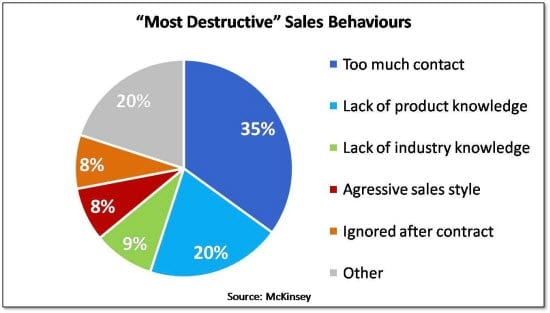
According to McKinsey, the greatest sales sin was “too much communication” in person, by phone or by email, followed by lack of knowledge about either their products or those of their competitors.  More than 6 times as many respondents complained of “too much communication” than those who complained of too little contact.

Can you over communicate?

So how are we to interpret this data?  First, I need to introduce the caveat that the survey appeared to span simple to complex products, and I think we all know that complex sales have important nuances that don’t apply to commodity purchases.  Second, the number of options open to those surveyed seems to have been restricted.

But even with these reservations, the conclusion that you can over communicate with your prospect appears troubling in a world of multiple touch points.  So I went back to the quantitative buyer research I’ve conducted in behalf of B2B clients – all of them involved in high-value complex sales – and I think I have at least one probable explanation.

Ensure that your prospect feels they are learning something

In almost every conversation with people involved in the B2B buying decision making process, I hear something along the following lines “for as long as I’m learning something, I’m prepared to listen.  But as soon as I detect a sales pitch, or feel I’m being chased, I switch off”.

So I’m coming to suspect that the real problem is not the frequency of the communication – but the relevance of the message to the buyer.  Repeatedly contacting the buyer to ask if they have made a decision yet is likely to be counter-productive.  But sharing some potentially valuable insights with them is likely to be taken in a completely different and more positive light.

Building rapport - ensuring relevance

So when I’m coaching sales people I strongly advise them to build a level of rapport with their prospects that allows them to understand what they are interested in – and to selectively identify insights and news items and to share learning from other similar customers that is likely to be of interest to their client and can help to sustain a continuing dialogue.

So – do you think that it’s possible to over-communicate with prospects, and what techniques have you found to avoid being seen as a bore?

Best Practices Checklist

Do you work for a B2B software developer or solution provider? I've captured many of today's best go-to-market practices in a 20-point self assessment checklist. You can download it here. Please take a few moments to complete it. I think you’ll find at least one idea that will help you create an even stronger foundation for the future.

p.s., if you found this article interesting, why not subscribe to our blog?

Comments

Yes this is a highly relevant topic Bob, particularly as we all tussle with the issues of translating “traditional” sales techniques, like cold calling on the telephone, into an online environment and the digital equivalents of emails, blogs, forums, online meetings, webinars and so on. 


The email in my inbox, before this one, was actually from a “business guru” inviting me to his entrepreneur and senior business folks “Summit” with the headline of… 


“Neil, Do you give up before 7?” 


…with the explanation in the body copy that a significant proportion of his audiences can take up to 100 such communications before they buy something from him. And I also consume acres of tat covering the dizzying joys that sales people should derive from the 999 “No’s” that lead to 1 “Yes”. 


So the advice – as a general business “noise” is conflicting, and I suspect that you are right in assessing this as more of the massive confusions between deciding whether we are in B2C (endless prospects) or B2B (sometimes as few as one, or only a comparative handful), and whether what we are attempting to communicate is a repeat advertising message or the start of a fresh or progressing dialogue/conversation. 


Buyers often don’t know the difference either though, given that they might complain bitterly about a second “message” from one source (I understand already) versus swearing blind that they could not possibly buy a product or brand until they’d heard or seen stuff about it at least 1,000 times (I’ve never heard of you – or my boss hasn’t). And equally to have a reliable and honest assessment built in to their replies to communications that can accurately predict whether they will ever purchase such a product or service and, if so, whether that will be a carefully assessed, transparent and justifiable process, or whether it might go winging through “the system” on more of a whim, when the chairman’s wife does happen to come across an advert in a magazine or been told by her tennis coach that it was “great”. 


Buyers are also somewhat prone (imho) to going back around a loop that has already been covered, ending up doing things and buying stuff that they had previously sworn, on their best granny’s grave, would indeed be a mark of complete insanity. And I haven’t met a salesperson yet who actually enjoys being held up in the buying/selling cycle somewhere, necessitating (yet) another contact. Our best communications, inevitably, are the ones that match buyer and seller needs and timings as closely as possible, and take the least fuss to get from initial contact to (first pot of) money in the bank. That’s not to say they are always the ones that sellers are most proud of achieving, of course, because there is a lot of pleasure/pride involved in winning a (big/profitable) deal that nonetheless had some “complications” en route, but in general this is true. 


Relevance Road, as Richard & Stephanie are suggesting, does seem to be the one to go down, but that will still require the genuine and honest feedback from the buyer that they are not going to do any of the above, and nor are they sitting on advice from their boss or FD to… 


“Go ahead and buy it, but wait till the end of the month/quarter, and I guarantee they’ll call back with a 10% reduction on that price.” 


Best regards - Neil
Posted @ Friday, May 14, 2010 4:15 AM by Neil Warren
I'll bet that if you make 2 calls where you unload the same information you just had "too much contact". If you call 50 times and each time you give the prospect some new and useful information - its probably "just right"
Posted @ Friday, May 14, 2010 1:20 PM by Phil Young
Interesting article Bob.  


The underlying challenge is making sure that what your prosect deems as valuable information is consistent with the information they receive. Far too often, sales reps send information that has little or no relevance to the prospect's situation. This type of communication is quickly tagged as a sales pitch. 


Thanks for your perspective. 


Kelley
Posted @ Tuesday, May 18, 2010 11:47 AM by Kelley Robertson
Post Comment
Name
 *
Email
 *
Website (optional)
Comment
 *

Allowed tags: <a> link, <b> bold, <i> italics